Patron Saint of Travelers: St. Christopher, His Medal and Other Travel Saints
Short answer: the patron saint of travellers is St. Christopher, an early Christian martyr whose name means "Christ-bearer". His feast is 25 July in the Western church and 9 May in the Orthodox church. Other saints linked to travel are the Archangel Raphael (journeys), Our Lady of Loreto (air travel), St. Nicholas (sailors), St. James (pilgrims) and St. Frances Xavier Cabrini (immigrants).
St. Christopher medals hang from rear-view mirrors and travel in wallets all over the world, even among people who know almost nothing about the saint. This guide explains who he was (as far as history can tell), why he became the protector of travellers, what changed in 1969, how Catholics actually use a St. Christopher medal, and which other saints people turn to for particular journeys.
Who was St. Christopher?
Historically, very little is known for certain. Christian tradition remembers Christopher as a martyr who died in the third century in Asia Minor, often dated to the persecution under the Roman emperor Decius around 250 AD. Churches were dedicated to him by the 5th century, which shows that his cult is old, but there are no reliable contemporary records of his life.
Almost everything people "know" about him comes from legend, above all the version in the Golden Legend, a hugely popular collection of saints' lives compiled by the Dominican Jacobus de Voragine around 1260. That medieval text, copied and retold for centuries, fixed the image of Christopher that is still on medals today.
The legend: the giant who carried a child across the river
In the Golden Legend, Christopher (originally called Reprobus or Offerus) is a giant from Canaan who wants to serve the greatest king in the world. He serves a king, then the devil, and leaves each one when he sees that they fear someone stronger. A hermit tells him that Christ is the greatest king and suggests a way to serve him: use his great size and strength to carry travellers across a dangerous river with no bridge.
One night a small child asks to be carried across. As Christopher wades into the river, the child grows heavier and heavier until the giant can barely reach the other bank. "You have put me in the greatest danger," he says, "it was as if I carried the whole world." The child answers that he has carried not only the world but the one who made it: he is Christ. From then on the giant is called Christophoros, the Christ-bearer.
The story explains everything about his patronage. He is the man who gets people safely across dangerous water, on foot, at night, when there is no other way over.
Why St. Christopher became the patron saint of travellers

Three things made Christopher the travellers' saint in medieval Europe:
- The ferryman story above: a saint whose whole vocation was carrying strangers safely across.
- A popular belief about "sudden death". Medieval Christians widely believed that anyone who looked at an image of St. Christopher would not die suddenly (unprepared, without the sacraments) that day. That is why huge Christopher murals were painted on church walls opposite the main door, where travellers passing by could see them. Many survive in English, German and Scandinavian churches.
- Pilgrimage. Pilgrims crossing Europe to Rome, Santiago de Compostela or Jerusalem faced rivers, mountain passes and bandits. Christopher was the natural protector to ask for help.
He was also counted among the Fourteen Holy Helpers, a group of saints venerated together in Germany and Central Europe from the 14th century, especially in times of plague. In the 20th century his patronage moved easily to motorists, pilots and anyone else on the move.
Was St. Christopher removed as a saint in 1969?
No. This is the most common misunderstanding about him. In 1969 the Catholic Church revised its General Roman Calendar, the list of feast days celebrated by the whole Latin Church. Many saints whose lives are known mainly through legend, Christopher among them, were taken off that universal calendar, and his 25 July feast stopped being a fixed celebration everywhere.
He was not "de-canonised". He remains in the Roman Martyrology, the official list of saints, and parishes, towns and countries where he is a patron still celebrate him, often on or around 25 July. Catholics remain free to venerate him and to carry his medal.
How St. Christopher is shown in art

Once you know the legend, the images are easy to read:
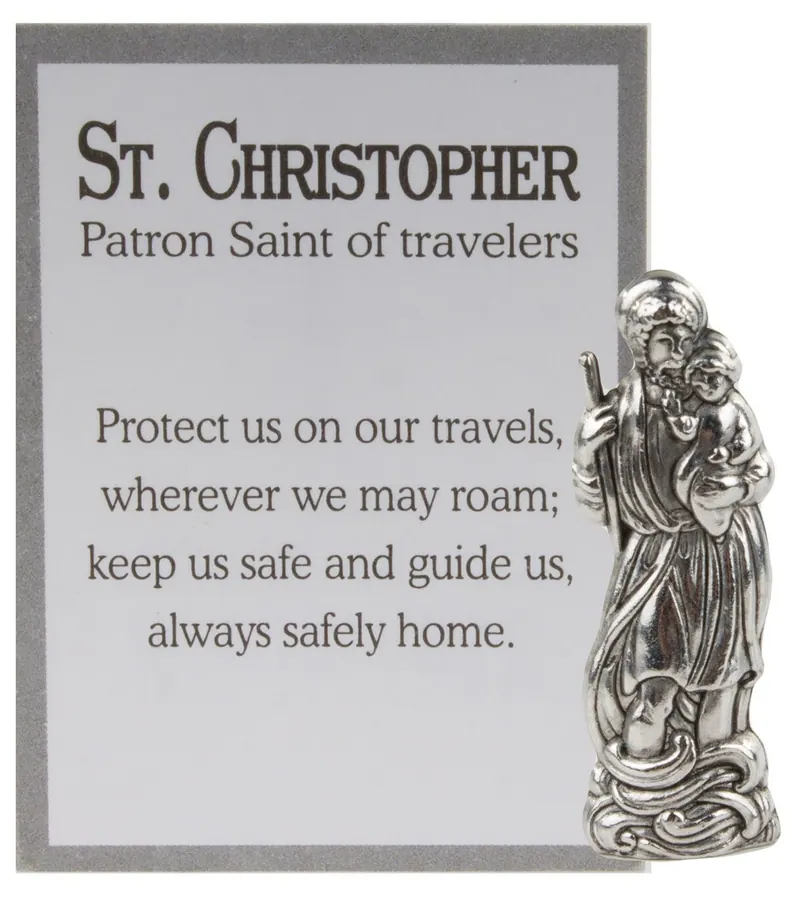
- A giant wading through a river, often with fish around his feet.
- A child on his shoulder, sometimes holding a globe (the "whole world" he carried).
- A staff in his hand, sometimes sprouting leaves. In the legend, the staff he planted on the riverbank blossomed the next day as a sign.
One of the earliest dated European woodcuts, the "Buxheim St. Christopher" of 1423 (now in the John Rylands Library in Manchester), shows exactly this scene. Hieronymus Bosch and Titian both painted him. In some Eastern Orthodox icons he appears with the head of a dog, which comes from a separate tradition that he belonged to a race of "dog-headed" people from the edges of the known world.
The St. Christopher medal: what it means and how to use it
A St. Christopher medal usually shows the giant with the child on his shoulder and the words "St. Christopher protect us" (or a version in another language). People wear them on a chain, carry them in a wallet or hang them in the car. They are popular gifts for:
- Someone leaving for a gap year, study abroad or a new job far away.
- A new driver getting their first car.
- Pilots, flight attendants, truck drivers and sailors.
- Confirmation, graduation and christening presents.
Is a St. Christopher medal a lucky charm?
In Catholic teaching, no. A blessed medal is a sacramental: a sign meant to remind the wearer to pray and to trust God, not an object with power of its own. The Catechism of the Catholic Church (paragraphs 1667-1670) explains sacramentals, and it treats believing that an object works by itself, regardless of faith, as superstition (paragraph 2111). In practice that means:
- Have the medal blessed by a priest, if you are Catholic. Any priest can bless it after Mass.
- Let it prompt a short prayer when you set off, rather than relying on it silently.
- Keep driving carefully. The saint who carried travellers would not approve of speeding.
Non-Catholics also wear St. Christopher medals as a sign of love from the person who gave it, and as a reminder to travel thoughtfully. That is a common and respectful use too.
Blessing of cars
In many parishes, especially in Europe and Latin America, the priest blesses cars, motorbikes and sometimes bicycles after Mass on the Sunday closest to 25 July. If you are travelling in late July, look for a notice outside local churches.
Prayers to St. Christopher
A short prayer before a journey
"St. Christopher, you carried Christ safely across the river. Pray for me on this journey: keep me from danger, help me travel with patience and kindness, and bring me home safely. Amen."
The traditional motorist's prayer
This prayer of unknown authorship has been printed on dashboard cards and holy cards for generations:
"Grant me, O Lord, a steady hand and watchful eye, that no one shall be hurt as I pass by. Thou gavest life, I pray no act of mine may take away or mar that gift of Thine. Shelter those, dear Lord, who bear me company, from the evils of fire and all calamity. Teach me to use my car for others' need; nor miss through love of undue speed the beauty of the world, that thus I may with joy and courtesy go on my way. St. Christopher, holy patron of travellers, protect me and lead me safely to my destination. Amen."
For prayers from other Christian traditions, from Judaism and Islam, and for help writing your own, see our guide to travel prayers for a safe journey.
Other patron saints for travel, by type of trip
| Trip or need | Saint | Why |
|---|---|---|
| Any journey | St. Christopher | The ferryman who carried the Christ child |
| Journeys and safe guidance | St. Raphael the Archangel | Guides and protects young Tobias on his journey in the Book of Tobit |
| Air travel and pilots | Our Lady of Loreto | Named patroness of aviators by Pope Benedict XV in 1920, because of the tradition that the Holy House of Nazareth was carried through the air to Loreto |
| Air travel (also students sitting exams) | St. Joseph of Cupertino | A 17th-century friar famous for reported levitation |
| Sailors and sea travel | St. Nicholas of Myra | Legends of calming storms at sea; patron of sailors and many port cities |
| Sea voyages | St. Brendan the Navigator | 6th-century Irish monk whose legendary voyage across the Atlantic was a medieval bestseller |
| Pilgrims and the Camino | St. James the Greater | His shrine at Santiago de Compostela; the scallop shell is the pilgrims' badge |
| Travellers needing lodging | St. Julian the Hospitaller | Legendary patron of travellers, innkeepers and ferrymen |
| Immigrants and people moving abroad | St. Frances Xavier Cabrini | Italian-American nun who served immigrants; named patroness of immigrants in 1950 |
| Lost luggage or documents | St. Anthony of Padua | The traditional saint for lost things |
Places to see St. Christopher on your travels
- Medieval wall paintings: many English parish churches still have large St. Christopher murals facing the main door. They are worth looking for when you visit country churches in England, Germany and Denmark.
- The Doge's Palace, Venice: Titian painted a fresco of St. Christopher there in the 1520s.
- The Camino de Santiago: pilgrims meet images of travel saints all along the route; St. James is the main one, but Christopher appears in many churches on the way.
- Town names: San Cristóbal, São Cristóvão, St. Kitts (Saint Christopher Island) and many others carry his name.
Planning a trip around December? Many of the medieval cities with the best Christmas markets also have churches with travel-saint art: see our guide to authentic Christmas markets.
Faith and common sense
Every tradition that honours St. Christopher also expects travellers to do their part. Carry the medal, say the prayer, then check the route, fasten the seatbelt and let someone know your plans. For the practical side, our emergency travel safety steps and solo female travel safety tips cover what to prepare before you go. More guides on faith and travel are in Travel Traditions.
Frequently asked questions
Who is the patron saint of travelers?
St. Christopher, a third-century martyr whose name means "Christ-bearer". According to legend he carried travellers across a dangerous river and one night carried the Christ child.
Is St. Christopher still a saint?
Yes. In 1969 his feast was removed from the Catholic Church's universal calendar because so little is known about his life, but he was not de-canonised. He remains in the Roman Martyrology and is still venerated.
When is St. Christopher's feast day?
25 July in the Western (Catholic and Anglican) tradition, where it is now kept locally, and 9 May in the Eastern Orthodox church.
What does a St. Christopher medal mean?
It asks for St. Christopher's prayers for a safe journey and is a reminder to trust God while travelling. In Catholic teaching it is a sacramental, not a lucky charm.
Who is the patron saint of air travel?
Our Lady of Loreto, named patroness of aviators by Pope Benedict XV in 1920. St. Joseph of Cupertino is also invoked by air travellers.
Can non-Catholics wear a St. Christopher medal?
Yes. Many people of other churches, or of no religion, wear one as a gift from someone who loves them and a reminder to travel safely.