
Travel Nanny vs Au Pair: Which Is Right for Your Family?
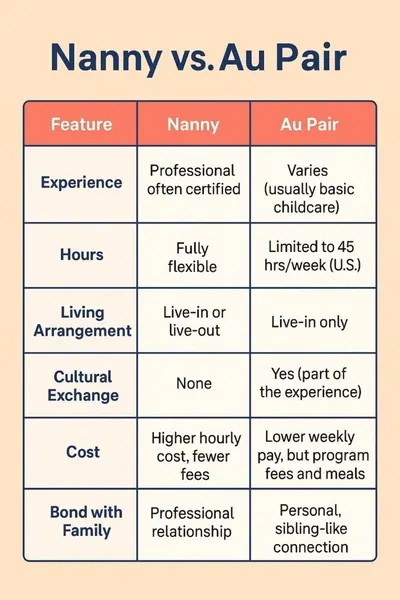
Short answer: a travel nanny is a professional childcarer you hire for a trip, paid a professional rate for set hours. An au pair is a young person on a cultural exchange who lives with your family for up to a year or two, helps with childcare for limited hours and receives a stipend, room and board. For a single holiday, a travel nanny is usually the right choice. For year-round help at home that can occasionally travel with you, an au pair may fit.
Both options put a caregiver in your family's daily life, but they are very different arrangements, legally and practically. This guide compares them side by side and explains how each one works for families who travel. The au pair rules here focus on the United States program. Other countries run their own schemes with different rules.
Travel nanny vs au pair at a glance
| Travel nanny | Au pair (US program) | |
|---|---|---|
| What it is | A professional job | A cultural exchange program with childcare duties |
| Typical length | One trip, from a weekend to several weeks | 12 months, with possible extensions |
| Who they are | Experienced nannies, any age | Young adults, 18-26, from abroad |
| Experience | Usually years of professional childcare | Some childcare experience required, often informal |
| Hours | Agreed per trip; overtime paid | Capped by program rules (in the US, up to 45 hours a week and 10 a day) |
| Pay | Hourly, daily or weekly professional rate plus expenses | Weekly stipend set by program rules, plus room, board and an education allowance |
| Where they live | Travel with you or meet you at the destination; their own room | In your home, in a private bedroom, all year |
| Arranged through | Nanny agency, or directly | A designated au pair sponsor agency only |
| Best for | Holidays, weddings, work trips, short-notice help | Ongoing help at home with some flexibility |
What is a travel nanny?

A travel nanny is a childcare professional hired specifically to look after your children while you travel. Some families take their regular nanny along; others book one through an agency for a particular trip. The nanny works agreed hours, is paid a professional rate, and the family covers flights, accommodation and meals. Many travel nannies have qualifications in childcare and are trained in paediatric first aid.
Our guide to hiring a travel nanny covers agencies, costs and contracts in detail.
What is an au pair?

"Au pair" comes from French and means "on equal terms": the au pair lives as part of the family rather than as staff. In the United States, au pairs come through the J-1 Au Pair exchange program run by the US Department of State. Only designated sponsor organisations can place them, and the program sets the rules on age, hours, stipend, study and time off. The au pair also takes classes at a US college or university during their stay, partly paid for by the host family.
Elsewhere, especially in Europe, au pair schemes are often lighter-touch arrangements with fewer hours, and rules differ widely by country. Always follow the rules of the country where the au pair will live.
Key differences that matter for travelling families
Can an au pair travel with you?
Often, yes. Host families commonly take their au pair on holidays, but program rules on working hours still apply on the trip, and travel abroad can affect the au pair's visa status and re-entry. Families should cover the au pair's travel costs and give them time off during the trip as normal. Check your sponsor agency's guidance before booking international travel with an au pair.
Experience and responsibility
A travel nanny is chosen for experience. They have usually handled jet-lagged toddlers, illness abroad and pool safety before. An au pair may be very capable, but is often young and new to working with children. For babies, children with complex medical needs, or a trip where you need fully independent care, a professional nanny is usually the safer choice.
Cost
Over a year, an au pair is often cheaper per hour of childcare than a nanny, though program fees, the stipend, room and board, the education allowance and car insurance add up. For a single trip, an au pair isn't an option at all unless one already lives with you, and a travel nanny is the only route.
Flexibility
A travel nanny can be booked for just the dates you need and for longer days, at an overtime rate. An au pair works year-round within fixed weekly limits, which suits regular school-day routines more than intense holiday weeks.
Living arrangements
An au pair lives with you all year and needs a private bedroom in your home. A travel nanny lives with you only for the trip, and needs their own room at the destination.
Which is right for your family?
Choose a travel nanny if:
- You need help for one specific trip.
- You have a baby or toddler, or a child with medical or additional needs.
- You want long working days during the trip (with paid overtime).
- You don't have space, or don't want someone living in your home year-round.
Choose an au pair if:
- You need regular childcare at home all year, such as before and after school.
- You like the idea of a cultural exchange and of your children learning about another culture or language.
- You have a private bedroom and can welcome someone as part of the family.
- Your trips are occasional and your au pair's normal hours would cover them.
Some families use both: an au pair at home and a professional travel nanny for a big trip, or for a trip when the au pair is on holiday.
Questions to ask before you decide
- How many hours of help do we really need, at home and on trips?
- Do we need someone with professional experience for our children's ages or needs?
- Do we have a spare bedroom year-round?
- What is our total budget, including fees, travel costs and taxes?
- Are we prepared to be a host family, with the time and support that involves?
A note for people who want to do the job
If you are on the other side, thinking of working with children while travelling, the routes are different too. Au pair programs are for young people who want a cultural exchange year. Travel nanny work is a career for experienced childcarers. Our travel nanny career guide explains how to get into it. And for destination ideas for a trip with children, see our family vacation ideas for July or browse Family Travel.
Frequently asked questions
What is the difference between a travel nanny and an au pair?
A travel nanny is a professional childcarer hired for a trip at a professional rate. An au pair is a young person on a cultural exchange who lives with a family for a year or more, helps with childcare for limited hours and receives a stipend, room and board.
Can an au pair travel with the host family?
Often yes, but program rules on hours and time off still apply, the family should cover travel costs, and international travel can affect the au pair's visa. Check with your sponsor agency first.
How many hours can an au pair work in the US?
Under the US Department of State J-1 au pair program, up to 45 hours a week and no more than 10 hours a day.
Is an au pair cheaper than a nanny?
Over a year, an au pair is often cheaper per hour of childcare. For a single trip, a travel nanny is usually the only practical option.