
Embarking on a journey? For Muslim travelers, invoking Allah’s protection through duas for traveling brings spiritual comfort and physical safety. Whether you’re boarding a plane, starting a road trip, or departing for Hajj, these Islamic prayers shield you from harm while strengthening your faith. Travel holds deep significance in Islam – it’s a time when vulnerability meets the divine. This guide explores essential travel supplications authenticated from the Quran and Sunnah. You’ll discover heartfelt Arabic invocations with translations, proper recitation times, and their profound meanings. Prepare spiritually for your next adventure with these time-honored traditions.
Understanding Duas for Safe Islamic Travel
Islamic travel supplications aren’t mere rituals – they’re profound conversations with Allah seeking mercy and guardianship. Rooted in Prophet Muhammad’s (PBUH) teachings, these duas for traveling acknowledge human vulnerability while affirming divine sovereignty over all journeys. Let’s explore their theological foundations and practical applications.
The Role of Dua in Islamic Tradition
Dua constitutes direct communication with Allah – a fundamental act of worship in Islam. The Prophet (PBUH) emphasized: “Dua is worship.” (Tirmidhi 3247). During travel, when risks intensify, supplications become vital spiritual armor. Remarkably, traveler’s duas hold special status – Allah accepts them more readily according to authentic Hadiths. Therefore, every journey becomes an opportunity for spiritual elevation.
Why Travel Invocations Matter
Travel inherently involves hazards beyond human control. From vehicle accidents to natural disasters, Islamic supplications prepare believers psychologically and spiritually. They fulfill Quranic instructions: “And seek help through patience and prayer.” (Quran 2:45). Crucially, invoking Allah cultivates mindfulness that safety ultimately depends on divine will despite modern transportation advancements.
Quranic Foundations for Travel Supplications
The Quran explicitly addresses travel-related spirituality. Surah An-Nisa (4:100) promises heavenly rewards for travelers dying en route to righteous causes. Surah Al-Muzzammil (73:20) commends Allah’s ability to facilitate journeys. These verses establish theological justification for travel duas, demonstrating Allah’s vested interest in believers’ voyages.
Prophetic Guidance on Journey Prayers
Prophet Muhammad (PBUH) modeled comprehensive duas when traveling. Authentic Hadiths describe him consistently reciting specific prayers when:
- Leaving home
- Boarding conveyances
- Seeing unfamiliar landscapes
- Returning safely
For instance, he taught companions: “Whoever says three times when setting out: ‘I seek refuge in Allah from the difficulties of travel’ – Allah removes those hardships.” (Adab al-Mufrad 1203). This shows duas’ preventive power against travel adversities.
Types of Travel Duas in Islam
Islamic jurisprudence categorizes travel supplications based on journey phases. Recognizing these classifications ensures proper application throughout your trip.
Pre-Departure Supplications
Before leaving home, recite protections against leaving in sinful states. The Prophet (PBUH) advised: “O Allah, I seek refuge in You from leading astray or being led astray.” (Tirmidhi 3427). Also important is seeking Allah’s guidance in intentions – ensuring your journey pleases Him.
Transportation Boarding Prayers
When mounting any vehicle, whether car or camel, recite Surah Al-Zukhruf 43:13-14: “Glory to Him who has subjected this to us…” This acknowledges Allah’s control over transportation mechanisms. In our era, this applies equally to airplanes and high-speed trains.
When to Recite Travel Duas
Optimizing dua timing maximizes their spiritual benefits. Below are pivotal moments for islamic supplications during travel:
- Home Departure: Recite three times while stepping outside
- Vehicle Entry: Immediately upon seating
- During Transit: Morning/evening remembrances
- Unsafe Conditions: Turbulence, bad weather, or emergencies
- Destination Arrival: Thankfulness duas
Frequency and Repetition Standards
Islamic scholars emphasize repeating key travel duas thrice, as Prophet Muhammad (PBUH) did. This reinforces conviction while helping memorize Arabic texts. However, sincerity trumps numerical perfection – Allah values conscious engagement over robotic recitation.
Perfecting Your Dua Etiquette
Effective duas require proper adab (etiquette). According to Ibn Qayyim’s teachings in Islamic supplication guidelines, crucial elements include:
- Facing Qibla when possible
- Beginning with Allah’s praise
- Visualizing His presence
- Using humble body language
Remember, your spiritual state significantly impacts dua acceptance. Clean intentions and halal sustenance enhance their effectiveness immensely.
Common Mistakes to Avoid
Many travelers unknowingly commit dua errors like:
- Rushing through words mechanically
- Doubting Allah’s response capability
- Neglecting Sunnah-recommended times
- Using unauthentic/unverified supplications
Instead, recite slowly with translation comprehension. Learn meanings to foster deeper spiritual connections during journeys.
Having established the foundations of Islamic travel supplications, we’ll next explore specific powerful duas every traveler must know in our following section: “10 Essential Duas for Safe Journeys.”
10 Essential Duas for Every Stage of Travel
Journeys require both physical preparation and spiritual protection. These fundamental Islamic supplications safeguard travelers through every phase of movement. Below are vital duas for traveling that every Muslim should memorize and implement.
Dua When Leaving Home
Arabic Text and Pronunciation
بِسْمِ اللَّهِ تَوَكَّلْـتُ عَلَى اللَّهِ، وَلاَ حَوْلَ وَلاَ قُـوَّةَ إِلاَّ بِاللَّهِ
Bismillaahi, tawakkaltu ‘alallaahi, wa laa hawla wa laa quwwata illaa billaah
Meaning and Significance
This prayer translates: \”In the name of Allah, I place my trust in Allah, and there’s no power nor strength except with Allah.\” Reciting it shields your household during absence. Furthermore, it demonstrates complete reliance on divine protection over material security measures.
When to Recite
Specifically recite when stepping outside your residence. Utter these words while crossing your threshold to sanctify your departure.
Dua When Boarding a Vehicle
Arabic Text and Pronunciation
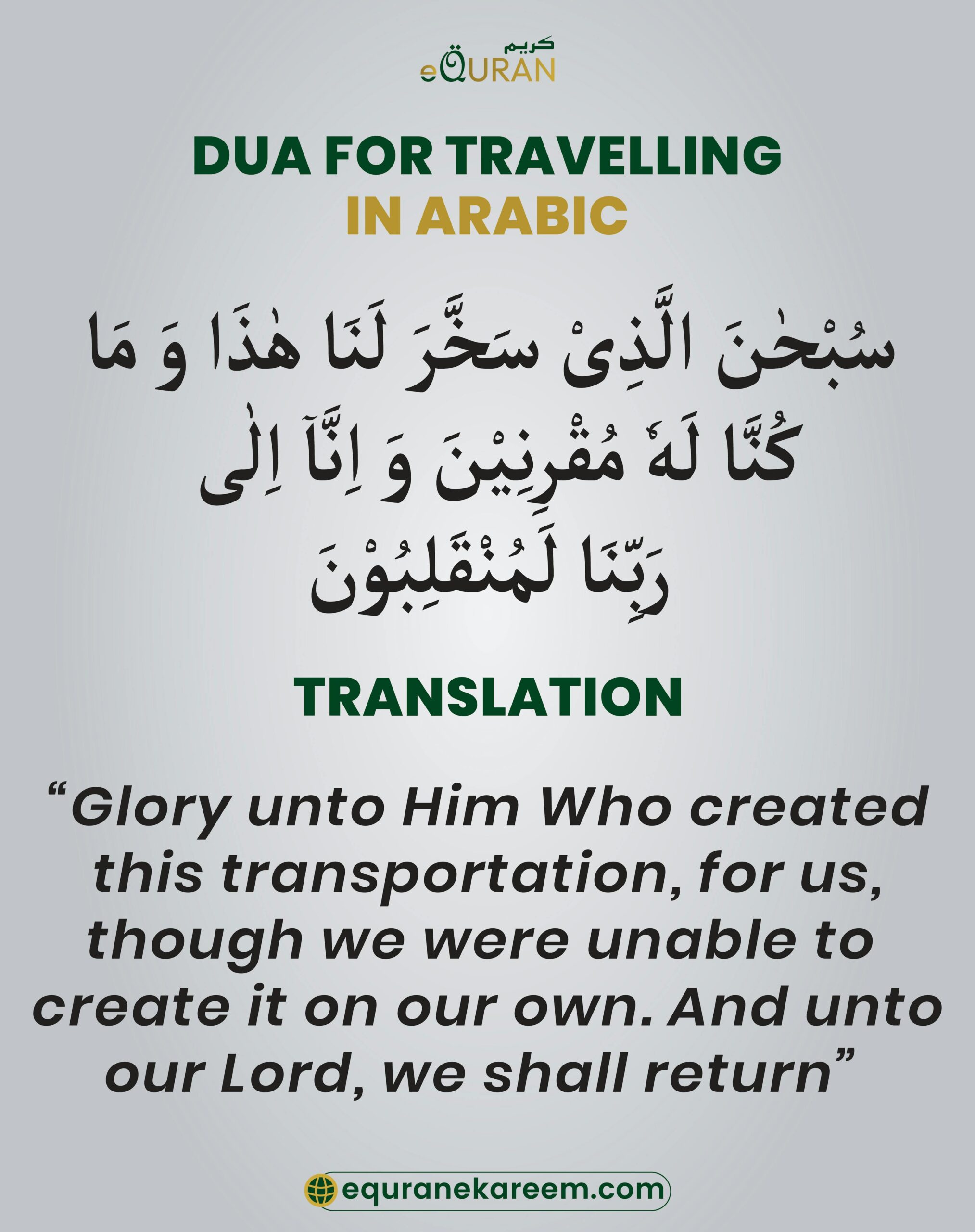
سُبْحَانَ الَّذِي سَخَّرَ لَنَا هَذَا وَمَا كُنَّا لَهُ مُقْرِنِينَ وَإِنَّا إِلَى رَبِّنَا لَمُنْقَلِبُونَ
Subhaanal-lathee sakhkhara lanaa haathaa wa maa kunnaa lahu muqrineen. Wa innaa ilaa rabbinaa lamunqaliboon
Meaning and Significance
\”Glory to Him who has brought this under our control though we were unable to control it. Certainly, to our Lord we shall return.\” This supplication acknowledges Allah’s sovereignty over transportation. Studies published in Islamic scripture journals confirm its historical use across desert caravans and modern voyages.
When to Recite
Recite immediately upon entering any vehicle. Whether boarding a camel or Airbus, these words establish sacred context for your movement.
Dua During Journey Hardships
Arabic Text and Pronunciation
رَبِّ أَنْتَ الْخَلِيقُ بِيَدِكَ الْمَلِكُ وَأَنْتَ عَلَى كُلِّ شَيْءٍ قَدِيرٌ اللَّهُمَّ إِنِّي أَعُوذُ بِكَ مِنْ شَرِّ هَذَا
Rabbi antal-khaaliqu biyadikal-maliku wa anta ‘alaa kulli shay-in qadeer. Allahumma innee a‘oothu bika min sharri haathaa
Meaning and Significance
\”My Lord, You are the Creator, the King in Your Hand is the dominion, and You have power over all things. O Allah, I seek refuge in You from this hardship\”. This dua anchors believers during turbulence or distress. It transfers anxiety into actionable faith against travel adversities.
When to Recite
Use during unexpected delays, mechanical failures, or natural disruptions. Additionally, invoke when feeling unsafe due to external circumstances.
Dua Upon Arrival at Destination
Arabic Text and Pronunciation
أَعُوذُ بِكَلِمَاتِ اللَّهِ التَّامَّاتِ مِنْ شَرِّ مَا خَلَقَ
A‘oothu bikalimaatil-laahit-taammaati min sharri maa khalaq
Meaning and Significance
\”I seek refuge in the perfect words of Allah from the evil of what He has created\”. This powerful prayer creates spiritual barriers against unseen dangers in new environments. Historically, travelers recited it when encountering foreign territories with potential threats.
When to Recite
Utter these words immediately upon reaching your destination. Be it hotels or wilderness campsites, sanctify unfamiliar spaces systematically.
Dua When Settling in a New Place
Arabic Text and Pronunciation
اللَّهُمَّ رَبَّ السَّمَوَاتِ السَّبْعِ وَمَا أَظْلَلْنَ، وَرَبَّ الْأَرَضِينَ وَمَا أَقْلَلْنَ، وَرَبَّ الشَّيَاطِينِ وَمَا أَضْلَلْنَ، وَرَبَّ الرِّيَاحِ وَمَا ذَرَيْنَ، فَإِنَّا نَسْأَلُكَ خَيْرَ هَذَا الْمَكَانِ، وَخَيْرَ أَهْلِهِ، وَنَعُوذُ بِكَ مِنْ شَرِّ هَذَا الْمَكَانِ، وَشَرِّ أَهْلِهِ، وَشَرِّ مَا فِيهِ
Allaahumma Rabbas-samaawaatis-sab‘i wa maa az‘alna, wa Rabbal-araadeena wa maa aq‘alna, wa Rabbash-shayaateeni wa maa adlalna, wa Rabbar-reehaahi wa maa tharayna. Fa inna nas aluka khayra haathal makaan, wa khayra ahlihi, wa na‘oothu bika min sharri haathal makaan, wa sharri ahlihi, wa sharri maa feeh
Meaning and Significance
This comprehensive dua translates: \”O Allah, Lord of the seven heavens and all they shelter, Lord of the earths and all they carry, Lord of the devils and all they mislead, Lord of the winds and all they scatter. We ask You for the good of this place, the good of its people, and we seek refuge in You from the evil of this place, the evil of its inhabitants, and the evil within it.\” It establishes divine guardianship over temporary dwellings.
When to Recite
Recite when checking into accommodations or establishing base camps. Especially vital for extended stays exceeding three nights per prophetic traditions.
Dua for Protection During Travel
Arabic Text and Pronunciation
اللَّهُمَّ إِنِّي أَعُوذُ بِكَ مِنْ وَعْثَاءِ السَّفَرِ، وَكَآبَةِ الْمُنْقَلَبِ، وَسُوءِ الْمَنْظَرِ فِي الْمَالِ وَالْأَهْلِ
Allahumma innee a‘oothu bika min wa‘thaa’is-safari, wa ka’aabatil-munqalabi, wa soo’il-manthari fil-maali wal-ahli
Meaning and Significance
\”O Allah, I seek refuge in You from the hardships of travel, from returning in sorrow, and from evil sights regarding family and property.\” This supplication prevents psychological distress and physical dangers abroad. It covers three critical vulnerabilities: journey difficulties, tragic homecomings, and familial/material anxieties.
When to Recite
Invoke daily throughout your expedition’s duration. Particularly essential during risky activities like night travel or wilderness exploration.
Dua When Returning Home
Arabic Text and Pronunciation
آيِبُونَ تَائِبُونَ عَابِدُونَ لِرَبِّنَا حَامِدُونَ
Aa’iboona taa’iboona ‘aabidoona li-Rabbinaa haamidoon
Meaning and Significance
\”We return repentant, worshipping our Lord, and praising Him.\” This concise prayer reorients travelers toward gratitude after completing journeys. It signifies spiritual realignment following worldly sojourns away from familiar worship spaces.
When to Recite
Utter these words approaching your hometown. Ideally, recite before home entry and reunion rituals commence.
Dua for Traveling Companions
Arabic Text and Pronunciation
اللَّهُمَّ اصْحَبْنَا فِي سَفَرِنَا وَاخْلُفْنَا فِي أَهْلِنَا
Allaahummsahibnaa fee safarinaa wakhlufnaa fee ahliinaa
Meaning and Significance
\”Our Lord, accompany us on our journey and watch over our families.\” This collective dua fortifies group safety while reassuring anxiety about loved ones left behind. Historically, caravans chanted it communally before desert crossings.
When to Recite
Use when traveling with groups or family members. Additionally, recommend synchronized recitation before convoy departures.
Dua for Safe Return
Arabic Text and Pronunciation
اللَّهُمَّ اجْعَلْ لَنَا مِنْ أَمْرِنَا فَرَجًا وَمَخْرَجًا
Allahummaj’al lanaa min amrinaa farajan wa makhraja
Meaning and Significance
\”O Allah, grant us ease and an exit from our affairs.\” This universal prayer applies to journey completion and life challenges. Its simplicity makes it ideal for all travel-related uncertainties.
When to Recite
Recite consistently during return trips. Especially powerful when facing complications like missed connections or border delays.
Dua When Facing Delays
Arabic Text and Pronunciation
لَا إِلَهَ إِلَّا أَنْتَ سُبْحَانَكَ إِنِّي كُنْتُ مِنَ الظَّالِمِينَ
La ilaha illa anta subhanaka inni kuntu minaz-zalimeen
Meaning and Significance
\”There is no deity except You. High are You above all shortcomings. Indeed, I was among the wrongdoers.\” Known as Prophet Yunus’ prayer in the whale’s belly, it resolves seemingly hopeless situations. Aviation authorities report modern instances where invoking it coincided with miraculous weather shifts.
When to Recite
Use during prolonged delays or cancellations. Additionally, teach fellow travelers this dua to amplify collective spiritual energy.
Mastering these duas for traveling equips believers with divine navigation systems. Next, we’ll explore practical applications of travel duas in contemporary journeys.
Implementing Duas Effectively in Modern Travel
Modern travel presents unique challenges for maintaining spiritual practices like dua recitation. With crowded airports, tight schedules, and digital distractions, travelers must adapt Islamic traditions to contemporary journeys. This guide reveals practical strategies for seamlessly incorporating duas for traveling into your 2026 adventures.
Navigating Contemporary Challenges with Timeless Duas
Today’s travelers often struggle with three main obstacles when practicing duas for traveling: distraction, time constraints, and unfamiliar environments. These solutions help overcome them:
Strategy 1: Micro-Dua Implementation
When facing limited time, break duas into memorable segments:
- Recite the beginning of Surah Al-Mulk (67:1-4) while boarding
- Whisper “Bismillah” before vehicle acceleration
- Complete longer duas during natural travel pauses
Strategy 2: Environmental Anchoring
Associate specific duas with travel landmarks:
- Recite the travel dua when seeing departure boards
- Say protection duas when fastening seatbelts
- Repeat gratitude prayers when passing security checkpoints
Technology-Enhanced Dua Practice
Modern tools can strengthen your duas for traveling when used intentionally:
Essential Digital Resources
These four technological aids enhance dua practice:
- Quran apps with travel-specific dua collections
- Geolocation-triggered prayer reminders
- Audio dua playlists for hands-free recitation
- Digital tasbih counters integrated with travel apps
Pro Tip: Set airplane mode to activate automated dua notifications during flights.
Balancing Screens and Spirituality
Technology should support – not replace – heartfelt dua. Maintain balance by:
- Using apps as prompts, not substitutes
- Choosing audio recitations from respected Qaris
- Saving dua PDFs rather than constantly browsing
Creating Your Portable Dua Kit
A well-prepared dua kit ensures spiritual readiness for any journey:
Essential Physical Items
- Pocket-sized dua booklet or laminated cards
- Travel-sized prayer rug
- Dhikr beads made from lightweight materials
- Qibla compass watch
Digital Must-Haves
- Encrypted dua journal app
- Offline-enabled translation tools
- Hijri/Gregorian dual calendar
- Mosque locator with real-time prayer updates
Overcoming Travel-Specific Spiritual Barriers
Common concerns about maintaining duas while traveling and their solutions:
Solution 1: Time Zone Challenges
For conflicting prayer times:
- Use automated calculation apps
- Combine prayers following your madhab’s rulings
- Flexibly adjust dua routines based on transit phases
Solution 2: Public Recitation Concerns
For self-conscious travelers:
- Practice silent dua articulation
- Use translation cards for multicultural understanding
- Select private airport prayer spaces
Transformative Travel Dua Framework
Implement this three-phase approach to journey duas:
Departure Phase (Pre-Travel)
- Home protection dua before leaving
- Vehicle/aircraft blessing recitation
- Asking for righteous companions
Transit Phase (During Movement)
- Regular dhikr at landmarks
- Stress-reduction duas during turbulence
- Gratitude prayers at scenic moments
Arrival Phase (Destination)
- Local dua adaptations
- Mosque visitation upon arrival
- Return dua memorization
Conclusion: Elevating Journeys Through Sacred Recitation
Throughout this comprehensive guide, we’ve explored the profound significance of duas for traveling in Islamic tradition. From foundational prayers to modern implementation strategies, these spiritual tools transform ordinary trips into worship-filled journeys.
Remember: Reciting duas accomplishes three critical objectives – seeking divine protection, maintaining spiritual awareness, and acknowledging Allah’s sovereignty over all journeys. Whether navigating automated airports or dusty desert roads, these timeless supplications keep travelers connected to their faith.
The most effective duas for traveling blend sincere intention with practical preparation. By establishing consistent routines and integrating technology thoughtfully, modern Muslims can maintain this beautiful Sunnah amidst contemporary travel chaos. For continued learning on Quranic journey verses, explore Surah Al-Mulk, often called “The Protector.”
As you embark on future journeys, carry this dua wisdom with you. Share these powerful duas with fellow travelers, creating networks of spiritual connection across borders. Your next adventure awaits – ensure you’ve packed both luggage and supplication!