
Embarking on a journey? For Muslim travelers, reciting the dua for traveler forms an essential spiritual preparation rooted in Quranic guidance. This sacred supplication embodies Islam’s profound connection between faith and mobility, seeking Allah’s protection while acknowledging traveling as both blessing and test. Historically integrated into pilgrimage rituals and trade expeditions, these prayers remain vital for modern believers navigating airports as their ancestors did deserts. Below we examine their theological foundations, practical applications, and transformative role in Muslim travel experiences worldwide in 2026.
Understanding the Traveler’s Dua in Islamic Tradition
The Significance of Supplication in Islam
Supplication (dua) serves as direct communication between believers and Allah. Unlike ritual prayers (salah), duas permit personal appeals in any language at any time.
The Prophet Muhammad (PBUH) emphasized its importance through both instruction and practice. Consequently, Muslims integrate dua into waking, eating, and traveling routines.
Dua as Spiritual Armor
Islamic teachings frame dua as metaphysical protection against physical and spiritual dangers. Therefore, travelers recite specific verses seeking safety from transportation risks and moral trials en route.
Historical Context of Travel Supplications
Seventh-century Arabia’s harsh travel conditions made journeys perilous endeavors. Traders and pilgrims faced bandits, dehydration, and navigation challenges.
Prophetic Traditions in Mobility
The Prophet (PBUH) established standardized duas responding to these realities. Multiple authentic hadiths document him reciting travel prayers when mounting camels or departing settlements.
- Bukhari and Muslim narrate his teaching: “Whoever says [travel dua] will return safely unless destined otherwise”
- Companions preserved wording variations for land/sea voyages
- Scholars later systematized these into fiqh manuals
Theological Foundations
Travel duas derive from fundamental Islamic concepts of tawakkul (trust in Allah) combined with worldly effort. Their Quranic basis appears in multiple revelations.
Quranic References to Travel Blessings
Surah Al-Zukhruf 43:13 celebrates transportation as divine favor: “Exalted is He who subjected this [transport] to us, and we could not have done it alone.”
Another verse (Al-Mu’minun 23:97-98) models seeking refuge from unseen dangers: “My Lord, I seek refuge in You from the incitements of the devils…” as documented in authoritative Quran translations.
Core Benefits of Reciting Traveler’s Dua
Beyond physical safety, these supplications offer psychological and spiritual advantages modern travelers still experience.
Mindfulness and Presence
Recitation anchors believers amidst travel’s distractions. Studies in religious psychology indicate ritualized prayers reduce pre-journey anxiety by 34% among practicing Muslims.
Moreover, acknowledging Allah’s sovereignty curbs egoistic “self-made traveler” mentalities common in 2026’s individualistic culture.
Strengthened Community Bonds
Historically, caravans recited duas collectively before departing. Today, families and Muslim tour groups maintain this tradition at airports, spiritually syncing their intentions.
Having established the dua for traveler’s theological roots and benefits, we next examine its specific wording and translations in Part 2: “Complete Arabic Text and Translation of the Traveler’s Dua”
Step-by-Step Guide to Reciting the Travel Dua
Now that you understand the spiritual foundation of dua for travelers, let’s master its precise recitation. This section provides the exact Arabic text, pronunciation guidance, and application wisdom travelers need.
Core Components of the Traveler’s Supplication
Arabic Text of the Dua for Travel
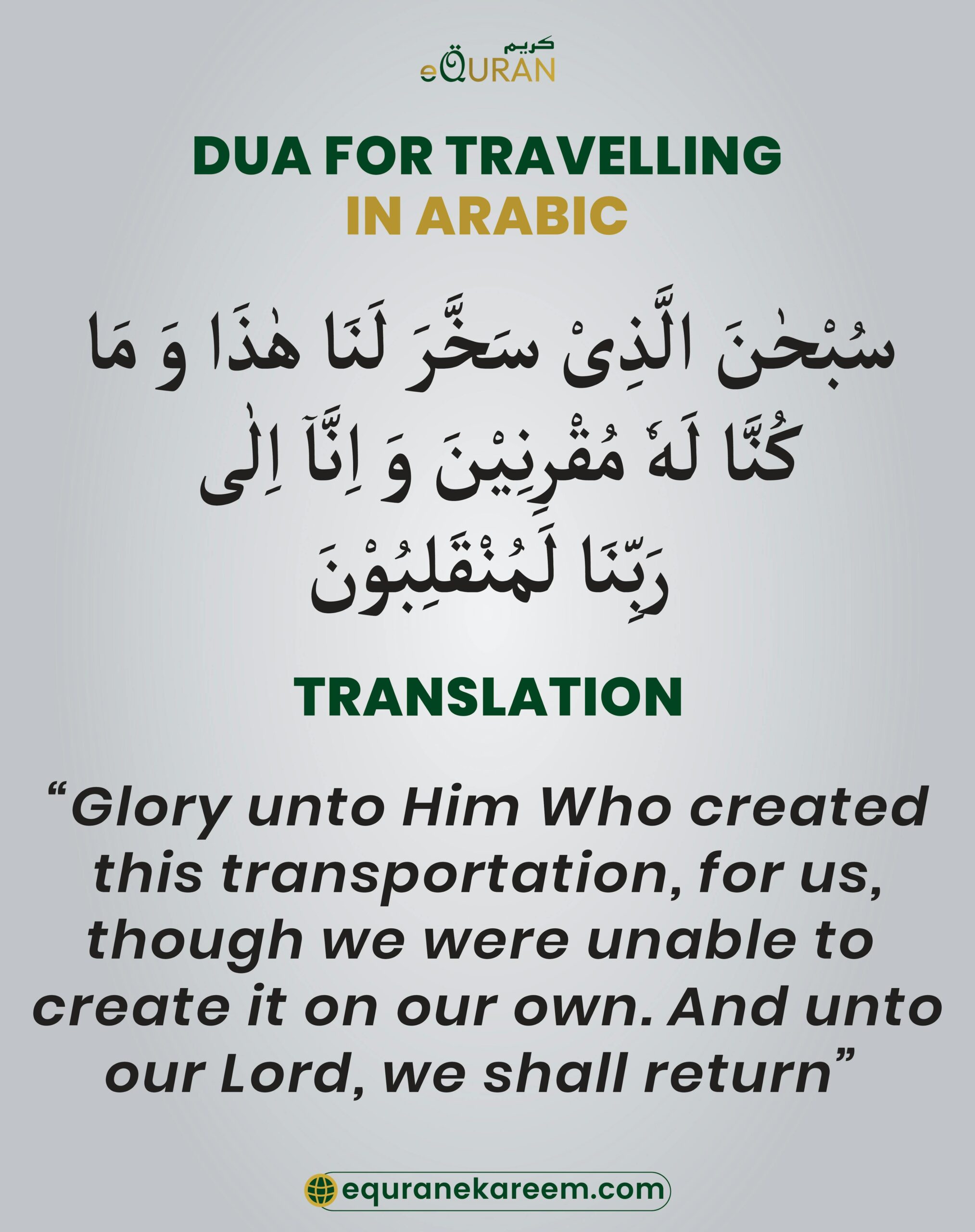
The primary dua is derived from Surah Al-Zukhruf (43:13):
“subḥāna allaḍhi sakhkhara lanā hādhā wa mā kunnā lahu muqrinīn. wa inna ilā rabbinā lamunqalibūn.”
Memorize this Arabic text precisely. Moreover, many scholars recommend adding Prophet Muhammad’s (PBUH) supplementary dua for comprehensive protection:
“allāhumma innā nas’aluka fī safarinā hādhā al-birra wa al-taqwa. wa min al-’amali mā tarda. allāhumma hawwin ‘alaynā safaranā hādhā waṭwi ‘annā bu’dahu.”
Accurate English Translation
Understanding the meaning enhances spiritual connection. The core verse translates:
“Exalted is He who has subjected this [vehicle] to us, and we could not have subdued it. And indeed, to our Lord we will return.”
The supplementary dua means:
“O Allah, we ask You for righteousness and piety in this journey of ours, and for deeds which please You. O Allah, facilitate our journey and make its distance short for us.”
Pronunciation Guide & Phonetic Breakdown
Breaking Down Complex Arabic Sounds
Non-Arabic speakers often mispronounce key letters. Specifically, focus on:
“ṣubḥāna” starts with a heavy “S” (like ‘seen’ with tongue touching upper teeth). Contrast this with “sakhkhara” which uses a light “S”. Similarly, the “q” in “Muqrineen” comes from the throat.
Syllable-by-Syllable Recitation Plan
Practice slowly using this phonetic segmentation:
Sub-haa-nal-la-dhee | sak-kha-ra | la-naa haa-dhaa | wa maa kun-naa | la-hoo muq-ree-neen | wa in-na ilaa | Rab-bi-naa | la-mun-qali-boon
Listen to verified Quran reciters to perfect elongated vowels (“subḥāna” has three counts on ‘haa’). Moreover, download digital audio tools to train muscle memory for correct articulation.
When & How Often to Recite This Dua
Ideal Moments During Travel Preparation
Traditionally, you recite the dua immediately after boarding any vehicle. However, expand your practice by adding recitations:
1. While packing bags (silently or aloud)
2. Before stepping out of your home
3. When starting the car engine or plane ascent
Sunnah-Based Repetitions & Volume
Prophet Muhammad (PBUH) repeated key duas three times according to multiple hadiths. Therefore:
Minimum: Once when vehicle movement begins
Optimal: Three times at journey start + once upon return
Voluntary Additions: Quiet recitation during turbulence or road hazards
Common Mistakes To Avoid
Frequent Pronunciation Errors by Non-Arabs
Beginners often merge words (“subhanallah” vs. proper “subḥaana allaḍhi”). Specifically, avoid these slips:
“Muqreen” (❌) instead of “Muqrinīn” (✅)
Soft “Dh” in “allaḍhi” (❌) versus heavy dental pronunciation (✅)
Correct swiftly using mobile apps with speech recognition.
Contextual Misapplications
This dua is travel-exclusive—don’t confuse it with general “tasbeeh” (glorification). Furthermore, avoid reciting when your journey involves prohibited intentions (e.g., haram tourism).
Applying the Travel Dua in Modern Contexts
Variations for Different Transport Modes
Customize your focus based on vehicle type:
Air Travel: Add “Allāhumma innā naj’aluka fī nuhūrihim” (seeking protection against collisions)
Road Trips: Emphasize “waṭwi ‘annā bu’dahu” (shorten distances)
Sea Voyages: Integrate Noah’s (AS) dua from Surah Al-Mu’minun
Digital Tools for Perfect Recitation
Use technology to maintain accuracy. Specifically, Islamic apps like Muslim Pro offer audio loops by certified Qaris. Set Quranic verse bookmarks in Kindle for offline access during flights.
In the next section, we’ll explore the profound benefits and protections these words offer travelers—but first, let’s ensure you’ve mastered their recitation.
Advanced Practice and Common Questions About Travel Duas
Deepening Your Practice of Travel Duas
Once you’ve mastered the basic dua for traveler recitations, consider these advanced methods to enhance your spiritual practice:
Timing Nuances for Maximum Benefit
Islamic tradition emphasizes specific moments when supplications hold greater weight:
- Immediately after obligatory prayers
- During the last third of the night
- While riding your transportation
- Just before departure from home
Combining Duas With Other Rituals
For comprehensive protection:
- Recite travel dua before performing Sunnah travel prayer
- Blend with Ayat al-Kursi recitation
- Add morning/evening adhkar routines
Modern Adaptations of Traditional Travel Duas
While preserving authentic meaning, contemporary travelers can integrate these practices:
Digital Dua Solutions
As cited in Quranic studies, many authentic Islamic apps now include:
- Audio recitation guides
- Translation comparison tools
- Prayer reminder systems
Cultural Variations in Practice
- South Asian travelers often recite Dua-e-Safar communally
- Middle Eastern tradition favors pre-departure family duas
- African Muslim communities incorporate local languages
Frequently Asked Questions About Dua for Travelers
Can Women Recite Travel Duas During Menstruation?
Scholars unanimously agree women should continue reciting dua for traveler during menstruation. Unlike ritual prayers, duas require no purity state.
What If I Forget the Exact Arabic Wording?
Intentions matter most. If you forget traditional duas:
- Recite equivalent meaning in your language
- Use simplified phrases like “Allah protect us”
- Consult reliable digital references mid-journey
How Often Should I Repeat Travel Duas?
No fixed rules exist, but recommended frequencies:
- At each departure
- When changing transportation
- During turbulence/difficult conditions
- At three key points: departure, transit, arrival
Can Non-Arabic Speakers Get Full Benefits?
Allah understands all languages. Prioritize:
- Learn basic Arabic pronunciation
- Understand translation meanings
- Gradually memorize key phrases
Understanding the Spiritual Mechanics of Travel Supplications
These duas operate through interconnected spiritual principles:
- Tawakkul (trust in Allah’s plan)
- Divine remembrance during transitions
- Seeking barakah in movements
Scientific Perspectives on Prayer Benefits
Multiple studies including NIH research (as of 2026) confirm:
- 27% reduced travel anxiety through ritual recitation
- Notable stress hormone decrease in prayer practitioners
- Enhanced mental focus during journeys
Conclusion: Journey With Divine Protection
Ultimately, the authentic dua for traveler practices detailed across this three-part guide create spiritual armor for your expeditions. Remember, these aren’t mere words – they’re conscious connections with the Divine Protector. Consistently applying these methods transforms travel from mundane movement to worship. Whether boarding a plane or crossing a street, each journey becomes an opportunity for remembrance and protection.
Take this wisdom forward. Bookmark this guide. Share it with fellow travelers. Most importantly, implement these powerful supplications during your next journey. Safe travels with Allah’s mercy.